What to Ask Before You Buy AR (Augmented Reality) for Your Home Decor Store

Picture a home decor store owner in Manchester. She sells mirrors, lamps, vases, and wall art from one shop and a website that ships across the UK. Her most common return reason is not damage. It is size. The mirror was bigger than the customer pictured. The lamp looked fine in the photo and wrong on the side table. She starts looking into AR, and every provider's website sounds the same. So she makes a short list and asks them all the same questions.
This is the plain-English version of those questions. They work for any store in the USA, the UK, Europe, the Gulf, or Australia, and they matter more than any feature list.
Question 1: Who builds the AR (Augmented Reality) views?
This is the question most providers hope you skip. Some sell you software only, a viewer that sits on your product pages. You supply every AR (Augmented Reality) view yourself, usually commissioned from 3D artists at roughly $100 to $500 per product. For a decor store with 200 pieces, that is the whole project before anything earns a pound.
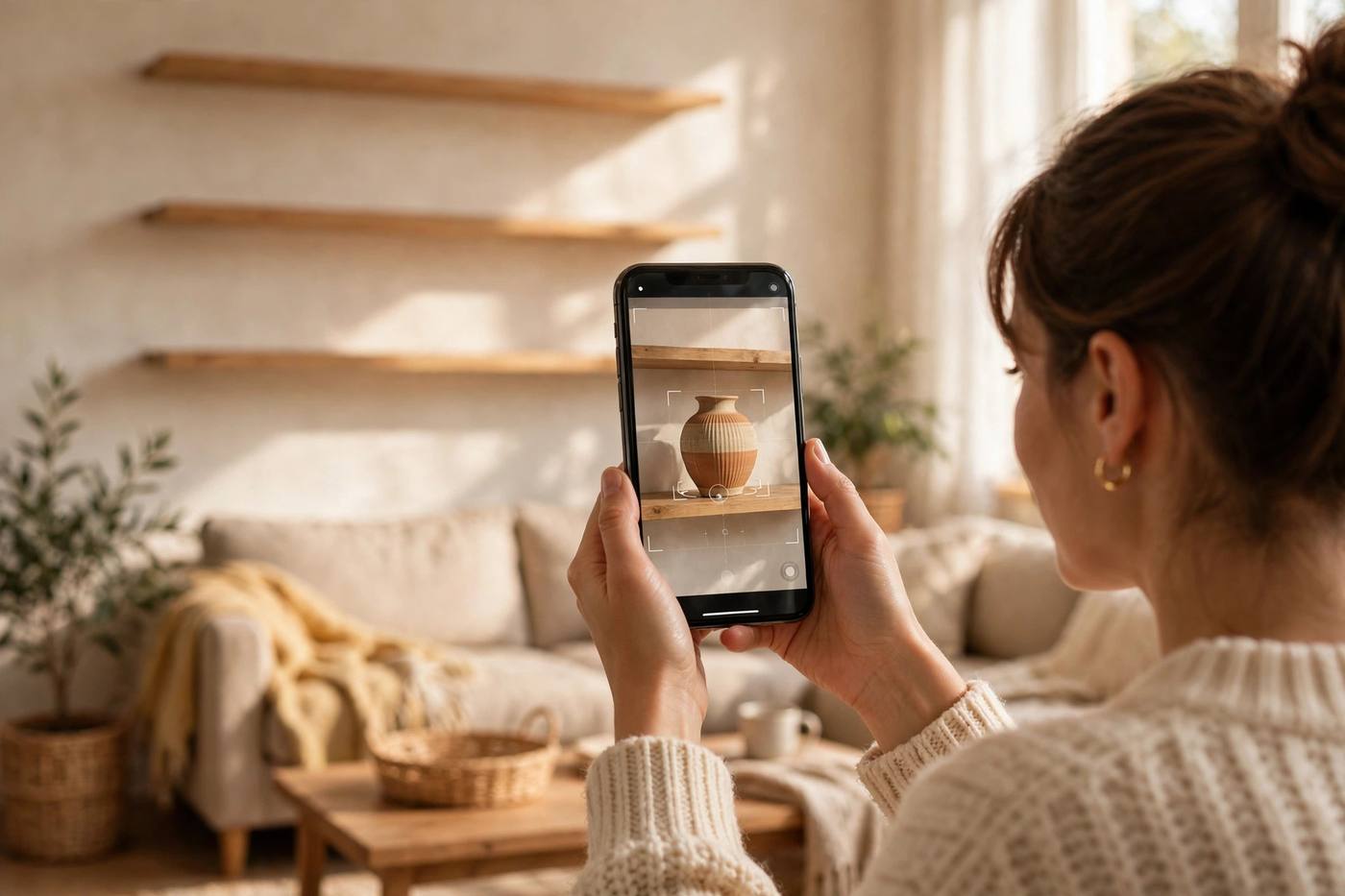
Ask it in writing: do you build the views for us, or do we have to find someone who does? A done-for-you service means you send product photos and the real listed dimensions and get working AR (Augmented Reality) views back. Ask who fixes a view if it looks wrong, and what that costs.
Question 2: How do you prove it is true to size?
Decor is a size business. A mirror that renders five centimetres too wide teaches your customer the tool cannot be trusted, and that customer will never measure with it again.
Ask how the provider checks every view against the real dimensions. We ask for the listed product dimensions and build each view to them, then check it against the real piece on a phone before it goes live. If a provider cannot describe their size check in one sentence, their views are approximate.
Question 3: Does my customer need to download an app?
If the answer is yes, most of your customers will never use it. People do not install apps to look at a vase. Browser-based AR opens from a link or a QR code in seconds, and that is the version that actually gets used. Test this yourself on your own phone with any provider's demo before you sign.
Question 4: What is the full cost for my first year?
Monthly fees are the easy part. Ask for everything: view building, setup, new season stock, per-view charges, and what happens to the views if you cancel. Add it all up for your catalogue size. Per-view fees quietly dwarf subscriptions on catalogues that change with the seasons.
Our price is public because we want this comparison: $249 one-time setup and $29 a month, with all view building included. No per-view fees, no product cap. Get every other provider's first-year total in writing next to it.
Question 5: How fast can a bestseller go live?
Ask for a written timeline for your catalogue size, starting from product photos. A service route should have a bestseller live in days and a full range in weeks. A software-only route depends on view turnaround plus your own integration work. Also ask what selling looks like after hours. Browsing peaks in the evening, when your shop is closed and your website is open. A shopper who can check the size at 10pm is a shopper who can buy at 10pm.

Shopify reports that products with 3D or AR views convert about 94% better than products without. That is Shopify's own data, not ours. The mechanism is simple: shoppers who can check the true size hesitate less.
For a broader look at the real routes a decor store can take, read the best AR options for home decor stores.
The cheapest way to check before you spend anything
You do not have to believe any article. Send a photo of your bestselling mirror, lamp, or vase and we will build you one true-to-size AR (Augmented Reality) view free. Put it on your own phone, check it against the real piece, and see if your customers would use it. If it does not convince you, you have spent nothing. Try the live decor demo first: it opens in your phone browser, no install.
Add one question to that list: what will this do to my returns? AR for decor stores: cutting returns with true-to-size views shows the side of AR that pays the bill.
FAQ
What should I ask an AR provider first?
Who builds the AR (Augmented Reality) views, how they verify true-to-size accuracy, and the full first-year cost in writing. Those three answers tell you more than any feature list.
Do my customers need an app?
Not with ARQR360. Each piece gets a link and a QR code that opens the AR view in the phone browser. Try the live decor demo on your own phone. Some providers need an app installed, so ask before you sign.
What does AR cost a small decor store?
It depends on who builds the AR (Augmented Reality) views, which is the biggest cost on most routes. ARQR360 is flat and public: $249 one-time setup and $29 a month, with all view building included. The first test view is free.
Try it on your own product, free
Reply with a photo of your bestselling product and we will build you one true-to-size AR model free, to try on your own phone. No commitment.
Get my free model