How Australian Decor Stores Cut Wrong-Colour Returns with AR (Augmented Reality)

Picture a home decor store owner in Melbourne. She sells lamps, wall art, vases, and mirrors online to shoppers all over Australia. Her pieces are good, her photos are good, and her reviews are good. Still, every week, pieces come back. Not because of defects. Because of colour. The lamp that looked warm brass on the screen looks dull yellow on the customer's side table. The wall art that looked soft sage in the photo looks cold green next to the customer's sofa. The shopper did nothing wrong. The screen did.
Colour is the quietest return reason in the decor trade, and often the biggest. Size gets the blame, because size is easy to measure. Colour is harder to argue about, so it hides inside the return numbers. This is how Australian decor stores cut it down, by letting the shopper check the true colour in her own room before she orders.
Why colour goes wrong on a screen
A product photo is taken under studio light, on a calibrated screen, by a photographer who knows the piece. The shopper sees it on a phone, in a bright kitchen, on a screen set to vivid. Then the piece arrives in a living room with warm lamps, a cream sofa, and a wooden floor that throws its own colour onto everything. Three different lights, three different colours, one lamp.
That is the whole problem. The shopper buys the photo. The piece she gets is the same piece, but her room changes how it looks. No size guide fixes that. No extra photo fixes it either, because every photo is still a photo of the piece in someone else's light.
What one wrong-colour return really costs
Take one example lamp, priced at $450. Say the shopper sends it back because the colour is wrong for her room. The store pays shipping both ways, call it $60 for the round trip. The lamp comes back with a scuffed shade or a loose fitting from the trip. It goes back up used and sells at a discount. Say $70 off. That is $130 gone on one lamp, before the time spent on emails, the refund, and the relisting.
Now picture the same store getting eight of those a month. That is more than $1,000 a month burned on pieces going out and coming back for a reason the store could have shown the shopper in advance. Run it with your own return count and your own shipping cost. The numbers change. The shape does not.
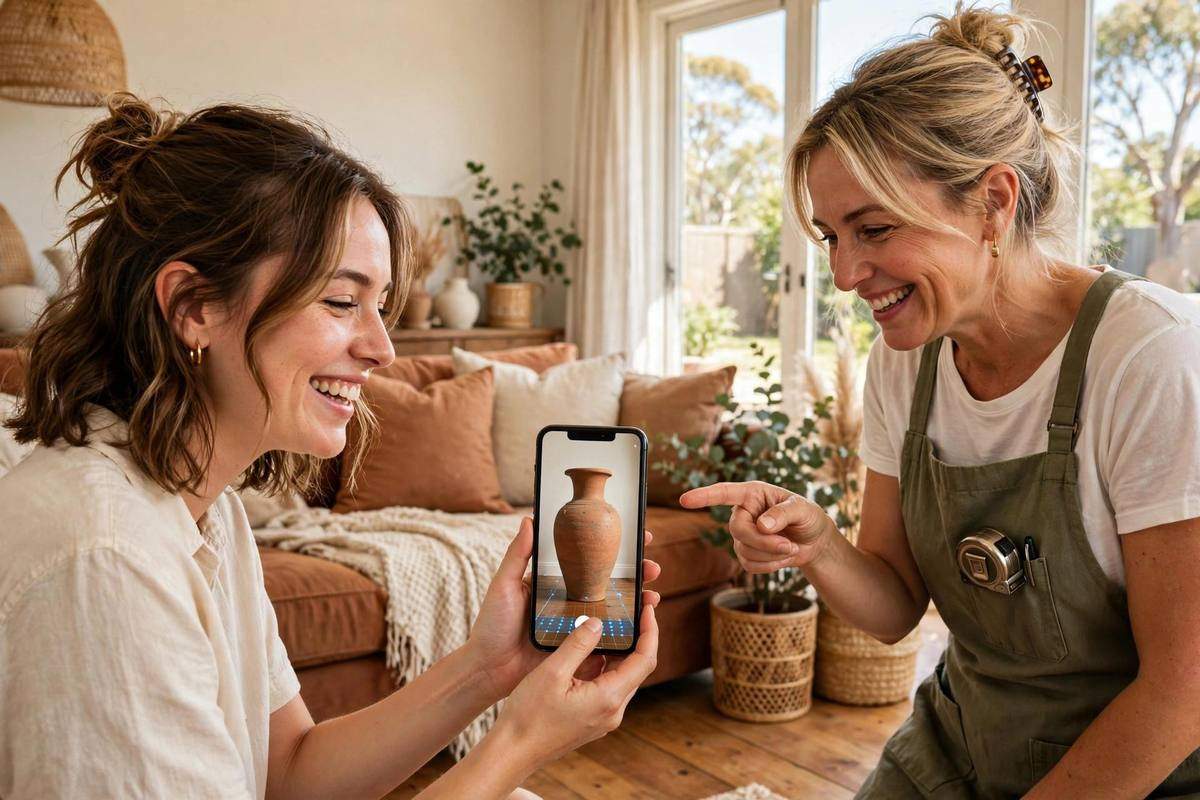
How shoppers check colour at home before they buy
AR (Augmented Reality) puts the piece in the shopper's own room, at its true size, in the light of her own home. She points her phone at the wall and the art appears there, next to her sofa, under her lamps. If the sage turns cold green against her wall, she sees it in ten seconds and picks another piece. If the brass holds its warmth, she orders with confidence and the lamp stays sold.
The check works because it happens where the piece will actually live. A flat photo asks the shopper to imagine. An AR (Augmented Reality) view asks her to look. That is the difference between a return and a kept piece.
Size and colour are checked in the same moment, which is why the two belong together. For the same angle in another market, read how US decor stores cut wrong-colour returns with AR.
Where the check belongs on your site
- Next to the price on every product page. That is where colour doubt lives. A see it in your room link beside the buy button answers the question at the moment it matters.
- On the price tags in the shop. A QR code on the tag opens the same piece in AR. Customers check it at home and come back decided.
- Bestsellers first. You do not need the whole catalogue on day one. Twenty proven pieces covering most of your revenue teach you what customers actually do with it.
- No app for the shopper. If the customer has to install an app, most will not, and your views never get used. Each piece should open in the phone browser from a link or a QR code. Try our live decor demo on your own phone.
The part most stores skip
Most decor stores stay away from AR for one reason. Somebody has to produce the views. The store owner has no design team and no wish to build one. This is where ARQR360 is built differently. You send product photos and your listed dimensions. Our designing department produces the true to size AR (Augmented Reality) views for you, matched to the real colours of your pieces. Photos in, views out.
Each piece gets a link and a QR code that opens in the phone browser. About seven days from photos to a live catalogue. The price is flat and public: $249 one-time setup and $29 a month, with all AR (Augmented Reality) view production included. No product cap, no per-view fees. Custom packages are available if your store needs something beyond the standard catalogue, and our team follows up after launch to make sure the views are working where shoppers actually see them.
One number worth knowing, and it is Shopify's own data, not ours. Products with 3D or AR views convert about 94% better than products without. Shoppers who can check the true size and true colour hesitate less, and shoppers who hesitate less buy more. If you want the worked maths for a small decor store, we ran it through in the payback maths for a small decor store.

The cheapest way to check if it works for your store
You do not have to believe an article. Send a photo of your bestselling lamp or vase and we will build you one true-to-size AR (Augmented Reality) view free. Put it on your own phone, check the colour against the real piece in your own shop light, and show it to your team. If it does not convince you, you have spent nothing. Start with the live decor demo on your own phone. It opens in the browser, no install.
FAQ
Why do decor colours look different online than in my room?
Photos are taken under studio light and viewed on phone screens set to vivid, while your room has its own lamps, wall colours and floor tones. The same piece looks different under each light. An AR (Augmented Reality) view shows the piece in your own room, in your own light, so you see the colour as it will actually look. Try the live decor demo on your own phone.
Do my customers need an app to see my decor in AR?
Not with ARQR360. Each piece gets a link and a QR code that opens the AR view in the phone browser. If a customer has to install an app, most will not use it, so ask every provider this question before you sign.
What does AR cost a small Australian decor store?
ARQR360 is flat and public: $249 one-time setup and $29 a month, with all AR (Augmented Reality) view production included. No product cap, no per-view fees. The first test view is free, so you can check the colour match against the real piece before spending anything.
Try it on your own product, free
Reply with a photo of your bestselling product and we will build you one true-to-size AR model free, to try on your own phone. No commitment.
Get my free model